
AbstractPeople often use 'nature-based tourism' and 'ecotourism' as if they mean the same thing. They do not, and the difference matters for nature and for the people who live in the places visitors come to explore.
A guided walk through a forest, a safari in a national park, a boat trip to see dolphins, a stay in a lodge surrounded by mountains: trips like these are often sold as 'eco' simply because they take place in nature. The idea behind this is that being close to nature must mean the trip is good for the environment.
But that is not always true. Nature-based tourism and ecotourism are closely linked, but they are different ideas. The words we use matter, because they shape what we expect tourism to do and who we expect it to help.
1. Nature-based tourism: a label, not a promise
Nature-based tourism is a broad term. It covers any tourism that happens in nature or depends on it, such as hiking, birdwatching, wildlife watching, kayaking and visiting national parks.
Natural area tourism takes many forms. Ecotourism, wildlife tourism, adventure tourism, marine tourism, nature photography and geotourism are key examples (Luyt and Van der Merwe, 2022). Ecotourism is only one of these, set apart by its focus on education, conservation and benefits for communities.
This form of tourism can yield considerable social, economic and environmental benefits. It helps people connect with nature, brings money into rural areas and can give communities a reason to protect wildlife and landscapes (Stronza, Hunt and Fitzgerald, 2019). But it is not automatically sustainable. Large-scale wildlife attractions, poorly managed trails and overcrowded tours, for example, can disturb animals, degrade habitats and exclude local people from the benefits.
These risks are often overlooked because outdoor recreation and other forms of nature tourism are frequently labelled as ecotourism, even though they were never designed to support conservation or local people (Stronza, Hunt and Fitzgerald, 2019). Yet when it is well managed, tourism can make a vital contribution to conservation.
In many parks, it pays for much of the conservation work itself. In Eastern and Southern Africa, nearly 80% of the annual budget of conservation authorities comes from tourism revenue (Cumming et al., 2021). Across developing regions in general, tourism likewise accounts for a large share of protected-area budgets (Morrison et al., 2012). In South Africa, national parks were set up first to conserve nature and then to bring in visitors, and tourism income has become vital as government funding has shrunk (Luyt and Van der Merwe, 2022).
The research evidence gives cause for concern. In a global review of 274 studies, Larson et al. (2016) found that more than 93% reported at least one effect of outdoor recreation on animals, and that most of these effects (59%) were harmful. Some of this harm is also difficult to detect. A review of 102 studies found that physiological measures tended to reveal stress in animals, even where their behaviour showed few clear signs of disturbance (Bateman and Fleming, 2017). Impacts on wildlife therefore need careful, long-term monitoring.
In short, nature-based tourism tells us where the tourism activity happens and what it depends on. It does not tell us whether that activity is responsible, fair or helpful.
2. What makes tourism truly 'eco'
Ecotourism asks for more. One of the earliest definitions, from The International Ecotourism Society, describes it as responsible travel to natural areas that protects the environment and improves the lives of local people (TIES, 1990). Orams (1995) soon pushed the idea further, arguing that ecotourism at its best should not only avoid harm but actively improve the environment and change how visitors think and act.
Ceballos-Lascuráin (1996) then defined ecotourism as responsible travel to relatively undisturbed natural areas to enjoy and appreciate nature, in ways that promote conservation, keep visitor impacts low and actively involve local people. As interest grew, so did the number of definitions: Fennell (2001) studied 85 of them, and Donohoe and Needham (2006) later found six ideas that keep coming up: a base in nature, conservation, education, sustainability, sharing the benefits, and acting responsibly.
So, protecting nature is essential, but it is not enough on its own. Most people link ecotourism with caring for the environment: cutting waste, avoiding damage to habitats, respecting wildlife and supporting national parks. These things matter. But a trip can still be sold as 'eco' while local people have little say in it, gain little from it and play no real part in running it. Researchers call this gap between green claims and real practice 'greenwashing' (Kundi and Ernszt, 2024).
Real ecotourism must answer a simple but important question: who benefits, and who decides?
3. Communities are not scenery
Tourism adverts often treat local people as part of the experience: they guide visitors, cook meals, perform cultural activities or simply live near the sights tourists come to explore. This picture is too narrow. Local people hold valuable knowledge, look after their environments, are key contributors to decision-making and are essential partners in making tourism fair and sustainable.
Real ecotourism should bring local people clear benefits, such as fair jobs, training, buying from local suppliers, new businesses and community-owned projects. It should also give communities a real say about what activities are offered, where visitors can go, how sites are run and how the money is shared.
Ecotourism can also build local skills. Guides for new nature-based activities can be recruited from communities living next to protected areas, which helps with skills development and poverty reduction (Luyt and Van der Merwe, 2022). In South Africa, national parks have been shown to benefit nearby towns through jobs and community upliftment (Saayman, Saayman and Ferreira, 2009). Ecotourism also gives people living near parks new ways to earn a living (Stronza, Hunt and Fitzgerald, 2019), and experts now recommend that local communities share in both the running of protected areas and the benefits they bring (Cumming et al., 2021).
Scheyvens (1999) created a well-known way to measure this. It looks at whether tourism gives communities more power in four areas: economic, psychological, social and political. Environmental and cultural areas have since been added (Scheyvens and van der Watt, 2021). This wider view ties community empowerment directly to sustainability and to the United Nations' 2030 Agenda for Sustainable Development, which sets out 17 Sustainable Development Goals (United Nations, 2015). Tourism is named in three of the goals' targets: target 8.9 calls for policies that promote sustainable tourism that creates jobs and promotes local culture and products, target 12.b for tools to monitor tourism's sustainability impacts, and target 14.7 for greater economic benefits to small island developing states and least developed countries, including through sustainable tourism (United Nations, 2015).
Research backs this up. A recent review of 33 studies on ecotourism in Borneo found that real community involvement brings both economic and environmental benefits, and that these last longer when communities have real power and strong networks (Hassan et al., 2026). Another review, of 71 articles, found that active involvement leads to better conservation, more income and stronger communities, though unequal power and unfair sharing of benefits are still common problems (Tiwari, Khatri and Marahatta, 2026).
The benefits are not always simple, either. A review of 30 years of ecotourism research found that money alone is not enough. Without fair sharing of benefits, secure land rights for local people and respect for what communities themselves want, ecotourism is unlikely to protect nature (Stronza, Hunt and Fitzgerald, 2019).
The lesson is clear: involvement must be real, not just for show. A community meeting held after the decisions have already been made is not shared decision-making.
4. Learning in both directions
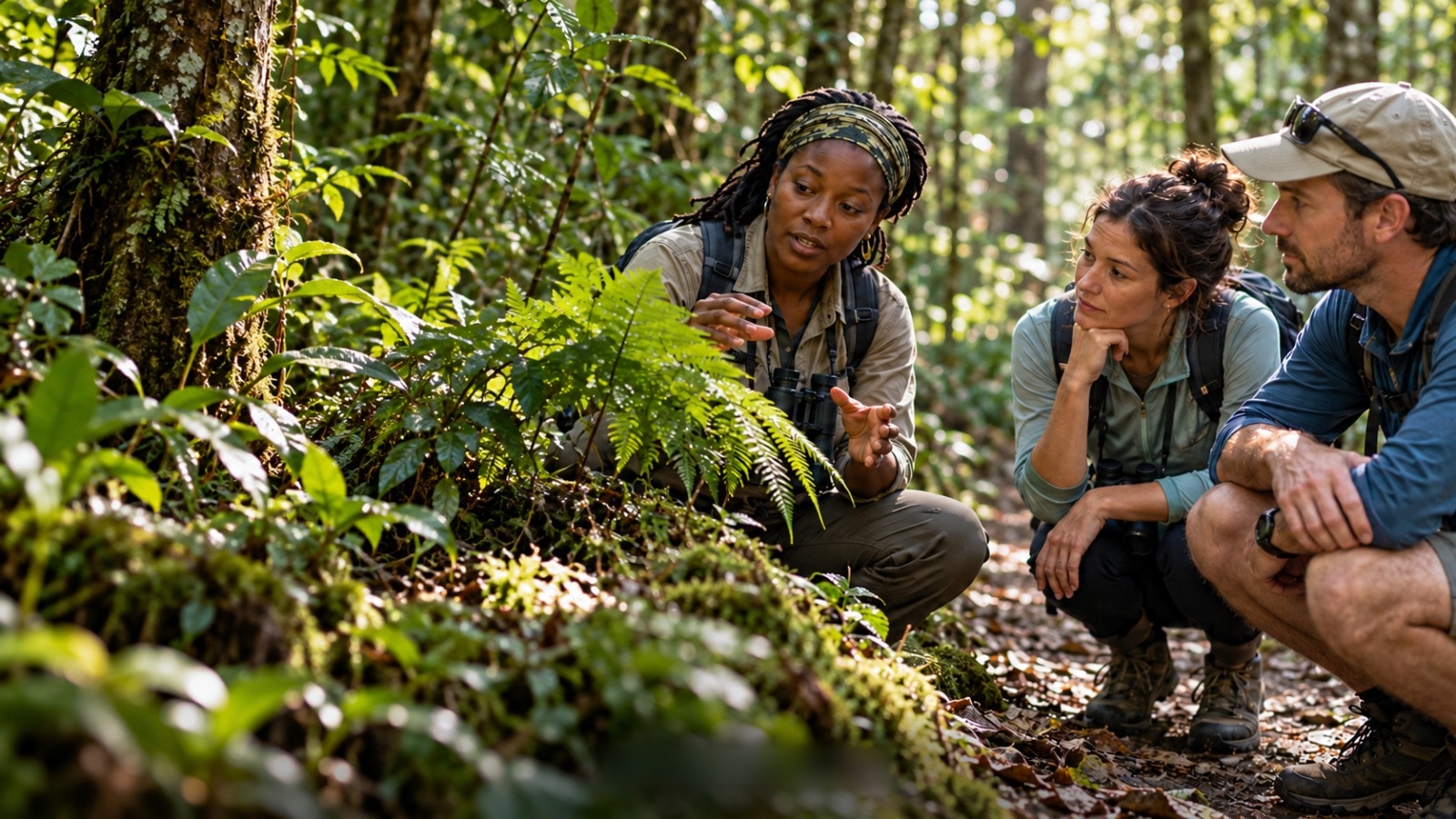
Education is another key part of ecotourism, and interpretation and education are now built into its most widely cited definition (Stronza, Hunt and Fitzgerald, 2019). Visitors should leave with more than photographs: they should gain a deeper understanding of the natural environment, local cultures, conservation challenges and everyday life of the places they have visited.
Good guiding and signage explain why certain rules exist, why keeping a distance from wildlife matters, why local customs deserve respect and how visitors' choices affect a place. Education helps local communities too, building awareness of the environment, pride in their culture and the skills they need to take part in tourism and conservation.
How this is done matters. Good interpretation can change what visitors know, how they feel and how they behave, even after they return home (Stronza, Hunt and Fitzgerald, 2019). For example, a survey of 745 participants on dolphin-watching tours in Hong Kong found that visitors who learned more from their tour guides were more likely to behave in environmentally responsible ways, and that this learning mattered more than how satisfied they were with the tour (Cheung et al., 2020). In other words, a tour that teaches does more for conservation than one that simply entertains.
Moscardo and Hughes (2023) go further. They argue that guides in national parks too often just point out sights, when they could use those sights to teach wider lessons about sustainability. My own experience of leading tours supports this. Animal sightings can sometimes be hours apart, and these quieter moments are exactly where guides can do what Moscardo and Hughes describe, using the surrounding landscape to teach visitors about the wider ecosystem. Doing so keeps visitors engaged and leaves them more satisfied; without it, they can quickly become bored.
Visitors often want this, and niche educational products can deliver it. In a previous study I conducted in 2022, I examined the potential of 'frogging' as a new ecotourism product for South African National Parks (Luyt and Van der Merwe, 2022). Frogging is the activity of searching for frogs in the wild to observe, listen to and learn about them. Frogs rarely attract the attention of ecotourists, as they are easily overshadowed by more charismatic wildlife, even though almost a third of the world's amphibian species are listed as threatened. Frogging therefore offers a way to combine conservation, visitor education and local job creation in a single niche activity.
The study (Luyt and Van der Merwe, 2022) surveyed 356 visitors to South African National Parks, and five main travel motives emerged: conservation, relaxation, biodiversity, new experiences and socialising. Conservation ranked highest, narrowly ahead of relaxation, while socialising mattered least. Many park visitors, in other words, want to feel that they are contributing to conservation, not simply enjoying the scenery. Most respondents agreed that nature-based tourism and ecotourism could help conserve frogs, wanted to learn more about them and would like their children to take part in frog-related activities. Half were interested in night walks to look and listen for frogs and 40% in frog identification activities, and the study was the first to identify frogs as a pull factor for visitors to natural areas (Luyt and Van der Merwe, 2022).
This points to a real opportunity. Niche nature-based products, such as guided night walks and species identification activities, can draw new visitors, teach them about overlooked parts of an ecosystem, raise money for conservation and create local jobs (Luyt and Van der Merwe, 2022).
When education works, everyone shares the responsibility. Visitors start to see themselves not just as customers, but as people helping to protect a place. Local communities, in turn, are seen as experts and partners, not just people tourism happens to.
5. From label to commitment
The word 'eco' is powerful. It suggests care, responsibility and sustainability. But a label alone does not make tourism good for nature. A better test is to look past the advertising and ask some practical questions:
- Does the experience actively contribute to conserving the natural environment?
- Are local people employed on fair terms and able to benefit economically?
- Do communities shape tourism decisions, rather than merely being affected by them?
- Are cultural knowledge and local perspectives treated with respect?
- Do visitors gain a meaningful understanding of nature, culture and conservation?
- Are negative impacts monitored and managed over time?
When the answer to these questions is yes, tourism can do much more than show off nature. It can help protect it, improve local livelihoods, build skills and support a healthier relationship between people and the places they depend on.
This is not only the job of tour companies, lodges or park managers. Visitors have a part to play too. Choosing responsible operators, respecting local customs, following conservation advice, supporting local businesses and being curious rather than just taking from a place all make travel more meaningful. When choosing operators, visitors should look for independent, third-party certification, such as certification by a body accredited by the Global Sustainable Tourism Council (GSTC), rather than relying on a business's own claim to be 'eco-friendly' (Global Sustainable Tourism Council (GSTC), 2025). Third-party audits give consumers a more credible basis for trust than self-declared labels, which can amount to little more than greenwashing (Darnall, Ji and Vázquez-Brust, 2018; Kundi and Ernszt, 2024).
In the end, ecotourism should be a promise, not just a label: a promise to protect nature, share benefits fairly, include communities in decisions and teach lessons that last beyond the trip. Nature-based tourism can be the starting point. Ecotourism is what happens when both nature and people truly benefit.
6. References
Bateman, P.W. and Fleming, P.A. (2017). 'Are negative effects of tourist activities on wildlife over-reported? A review of assessment methods and empirical results', Biological Conservation, 211, pp. 10–19. Available at: researchportal.murdoch.edu.au
Ceballos-Lascuráin, H. (1996). Tourism, ecotourism, and protected areas: the state of nature-based tourism around the world and guidelines for its development. Gland and Cambridge: IUCN.
Cheung, L.T.O., Ma, A.T.H., Lam, T.W.L., Chow, A.S.Y., Fok, L. and Cheang, C.C. (2020). 'Predictors of the environmentally responsible behaviour of participants: an empirical investigation of interpretative dolphin-watching tours', Global Ecology and Conservation, 23, e01153. Available at: doaj.org
Cumming, T., Seidl, A., Emerton, L., Spenceley, A., Golden Kroner, R., Uwineza, Y. and van Zyl, H. (2021). 'Building sustainable finance for resilient protected and conserved areas: lessons from COVID-19', PARKS, 27 (Special Issue), pp. 149–160. Available at: doi.org/10.2305/IUCN.CH.2021.PARKS-27-SITC.en
Darnall, N., Ji, H. and Vázquez-Brust, D.A. (2018). 'Third-party certification, sponsorship, and consumers' ecolabel use', Journal of Business Ethics, 150(4), pp. 953–969. Available at: doi.org/10.1007/s10551-016-3138-2
Donohoe, H.M. and Needham, R.D. (2006). 'Ecotourism: the evolving contemporary definition', Journal of Ecotourism, 5(3), pp. 192–210. Available at: doi.org/10.2167/joe152.0
Fennell, D.A. (2001). 'A content analysis of ecotourism definitions', Current Issues in Tourism, 4(5), pp. 403–421. Available at: doi.org/10.1080/13683500108667896
Global Sustainable Tourism Council (GSTC). (2025). GSTC certification. Available at: gstc.org (Accessed: 20 October 2026).
Hassan, M.S., Ibrahim, M.S.N., Pengiran Bagul, A.H.B., Saikim, F.H., Yusrini, L., Mohd Zainol, R. and Mohd Yahya, A.S. (2026). 'Local community involvement and its impacts on ecotourism development in Borneo: a systematic review', Discover Environment, 4, 58. Available at: doi.org/10.1007/s44274-026-00579-6
Kundi, V. and Ernszt, I. (2024). 'Safeguarding natural environment in tourism—and the phenomenon of greenwashing', Journal of Infrastructure, Policy and Development, 8(8), 5000. Available at: doi.org/10.24294/jipd.v8i8.5000
Larson, C.L., Reed, S.E., Merenlender, A.M. and Crooks, K.R. (2016). 'Effects of recreation on animals revealed as widespread through a global systematic review', PLoS ONE, 11(12), e0167259. Available at: doi.org/10.1371/journal.pone.0167259
Luyt, Z. and Van der Merwe, P. (2022). 'The potential of frogging as an ecotourism product for South African National Parks', Koedoe, 64(1), a1725. Available at: doi.org/10.4102/koedoe.v64i1.1725
Morrison, C., Simpkins, C., Castley, J.G. and Buckley, R.C. (2012). 'Tourism and the conservation of critically endangered frogs', PLoS ONE, 7(9), e43757. Available at: doi.org/10.1371/journal.pone.0043757
Moscardo, G. and Hughes, K. (2023). 'Rethinking interpretation to support sustainable tourist experiences in protected natural areas', Journal of Interpretation Research, 28(1), pp. 76–94. Available at: doi.org/10.1177/10925872231158988
Orams, M.B. (1995). 'Towards a more desirable form of ecotourism', Tourism Management, 16(1), pp. 3–8. Available at: doi.org/10.1016/0261-5177(94)00001-Q
Saayman, M., Saayman, A. and Ferreira, M. (2009). 'The socio-economic impact of the Karoo National Park', Koedoe, 51(1), pp. 26–35. Available at: doi.org/10.4102/koedoe.v51i1.158
Scheyvens, R. (1999). 'Ecotourism and the empowerment of local communities', Tourism Management, 20(2), pp. 245–249. Available at: doi.org/10.1016/S0261-5177(98)00069-7
Scheyvens, R. and van der Watt, H. (2021). 'Tourism, empowerment and sustainable development: a new framework for analysis', Sustainability, 13(22), 12606. Available at: doi.org/10.3390/su132212606
Stronza, A.L., Hunt, C.A. and Fitzgerald, L.A. (2019). 'Ecotourism for conservation?', Annual Review of Environment and Resources, 44, pp. 229–253. Available at: doi.org/10.1146/annurev-environ-101718-033046
The International Ecotourism Society (TIES). (1990). What is ecotourism? Available at: ecotourism.org (Accessed: 18 October 2026).
Tiwari, S., Khatri, B.B. and Marahatta, D. (2026). 'Exploring the role of community participation in sustainable ecotourism: a systematic review', Space and Culture, India, 13(4), pp. 65–80. Available at: doi.org/10.20896/z98psp53
United Nations. (2015). Transforming our world: the 2030 Agenda for Sustainable Development (A/RES/70/1). New York: United Nations General Assembly. Available at: sdgs.un.org (Accessed: 20 October 2026).